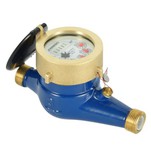
A mechanical water meter is a device that can measure the flow of water and is widely used in hydraulic systems around the world. With the continuous development of technology, mechanical water meters have also undergone continuous improvement and upgrading. Currently, there are mainly the following types on the market:
1. Mechanical water meter
Mechanical water meters are the most basic type, using the principle of direct measurement to convert the water flow through the water pipe into a reading. Its structure is relatively simple, operation and maintenance are relatively easy, and the price is also relatively cheap. It does not require additional energy supply, so it has been widely used in some basic application scenarios.
2. Turbine water meter
The turbine water meter is an improvement made on the mechanical water meter, using the turbine measurement method to measure water flow rate. It installs the turbine device in the water flow channel, uses the water flow to impact the turbine and drive it to rotate, thereby measuring the effluent flow rate. Due to the adoption of new measurement principles, turbine water meters have higher measurement accuracy and are slightly more expensive than mechanical water meters, but they are still one of the more widely used equipment.
3. Ultrasonic water meter
The ultrasonic water meter adopts the principle of sound wave detection, which measures the water flow rate by emitting sound waves and receiving the rebounded sound waves. Its advantage is that the measurement is very accurate and not easily affected by water quality. In addition, compared to mechanical water meters, it adopts a non-contact measurement principle, so its service life is longer. Of course, its price is also much higher than that of mechanical water meters.
4. Valve type water meter
The valve type water meter combines the water meter and valve, and is installed on the pipeline to monitor water flow and regulate water pressure. It can be monitored and controlled through remote communication systems, thereby improving the efficiency and convenience of water supply management, and is currently the most widely used type.
Although mechanical water meters have a simple structure, they may have certain measurement errors due to various factors, while ultrasonic water meters adopt new measurement principles and can accurately measure, but their prices are relatively high. Various types of mechanical water meters have their own advantages and disadvantages, suitable for different scenarios to choose from.