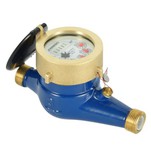
Remote-reading water meters are modern water meters that, with advancements in research and technology, can be further categorized into three different types: dry-type, wet-type, and liquid-sealed. Although they look very similar, the differences between them are quite significant. However, some people are not very familiar with water meters, which can lead to purchasing the wrong type. Below, we will explain the differences between dry-type, wet-type, and liquid-sealed water meters.
Dry-type Water Meters
First, there are dry-type water meters. Dry-type water meters transmit measurement data using pneumatic and electronic technology; the entire transmission process does not involve water. Their characteristics include a simple structure, convenient operation, relatively lower price, and good waterproof performance. A significant advantage is their applicability to various environmental conditions, such as high and low temperatures.
Wet-type Water Meters
Secondly, there are wet-type remote-reading water meters. Wet-type water meters transmit measurement data through a water seal; the entire transmission process involves water. Their characteristics include a more complex structure, but higher measurement accuracy. Furthermore, because the transmission process involves water, it effectively prevents oxidation and contamination.
Liquid-sealed Water Meters
Finally, there are liquid-sealed water meters. Liquid-sealed water meters are very similar to wet-type remote-reading water meters, but are more advanced. They also transmit data through a water seal, but unlike wet-type meters, liquid-sealed meters use a polymer material to isolate the inner core from the outer layer, and inject a high-performance liquid into the insulating layer. This liquid has better conductivity than ordinary water, resulting in higher accuracy and precision.
Although dry-type, wet-type, and liquid-sealed remote-reading water meters differ, they share some common characteristics, such as intelligent and remote measurement functions.
Dry-type water meters have the advantage of a relatively lower price, while wet-type and liquid-sealed water meters can measure and transmit data more accurately. Moreover, they are all suitable for various applications, such as residential, commercial, and industrial settings, meeting diverse usage needs. As discussed above, dry-type, wet-type, and liquid-sealed remote-reading water meters each have their own advantages and disadvantages. Different types of water meters have different characteristics and strengths, and no single type of water meter is suitable for all applications. The choice of water meter often depends on the user's actual needs and circumstances, taking into account various factors such as price, accuracy, and scope of application. By selecting the appropriate water meter, accurate measurement of water consumption can be achieved.