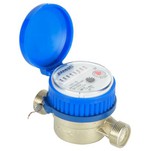
The accuracy of water meter measurement is of paramount importance in safeguarding the interests of both water suppliers and consumers.
1. Select Water Meter Models in Accordance with Standards
When selecting a water meter model, it is essential to make an appropriate choice based on the user's water consumption volume, water quality, water pressure, and pipe diameter. For instance: for users with low water consumption or minimal flow fluctuations, it is recommended to select a rotary-vane type water meter with a diameter of less than 40 mm; for users with high water consumption, a helical-vane type water meter with a diameter exceeding 50 mm is recommended; if the water quality is turbid, it is advisable to select a dry-type water meter, in which the counting mechanism is isolated from the water flow; if the water temperature is below 30°C, a cold-water meter should be selected; conversely, if the water temperature exceeds 30°C, a hot-water meter is required.
2. Strengthen Standards for Water Meter Manufacturing
The manufacturing quality of water meters serves as a crucial prerequisite for ensuring their accuracy. Therefore, it is necessary to strengthen supervisory and management efforts regarding water meter manufacturers to strictly prevent substandard meters from leaving the factory. Furthermore, purchasing entities should insist on procuring meters from reputable manufacturers, and all purchased meters must be accompanied by a Quality Certificate and a Water Meter Verification Certificate.
3. Ensure Standardized Water Meter Installation
The standardized installation of water meters is absolutely essential. During the installation process, full consideration must be given to the meter's safety, accessibility, and reliability. Water meters should be installed within straight sections of the piping, and it is imperative to ensure that the pipe operates under full-flow conditions. The length of the straight pipe section downstream (on the outlet side) of the water meter must be no less than five times the pipe diameter, while the length of the straight pipe section upstream (on the inlet side) must be no less than ten times the pipe diameter. Prior to installation, any obstructions within the inlet and outlet ports should be thoroughly cleared to minimize the likelihood of future blockages. If a water meter is installed outdoors, a protective housing must be provided; furthermore, meters should not be installed in locations subject to extreme cold or direct sunlight, and appropriate anti-freezing measures must be implemented during the winter season. When installing a water meter horizontally, its inclination must not exceed 1.5 degrees; additionally, ensure that the meter face is oriented upward and that the directional arrow aligns with the direction of the water flow. Different specifications of water meters require distinct installation methods; in all cases-whether regarding installation orientation or the lengths of the upstream and downstream straight pipe sections-the installation must strictly adhere to the specific requirements for the water meter in question.
4. Enhance the Operation and Maintenance of Water Meters
Routine maintenance tasks primarily encompass the following aspects: checking the joints of all water meter components for leaks-any leaks detected must be addressed immediately; verifying that the water meter is operating normally and that the sensitive pointer is rotating; and inspecting the meter's glass face to determine if cleaning is required to ensure it does not obstruct accurate readings. Furthermore, for large-diameter water meters used to measure raw water-as well as meters handling water with high concentrations of suspended solids and impurities-a thorough flushing and cleaning must be performed on the packed-bed filters and screens installed upstream of the inlet.